
American FET
The 500-series FET compressor that put the snap in American records.
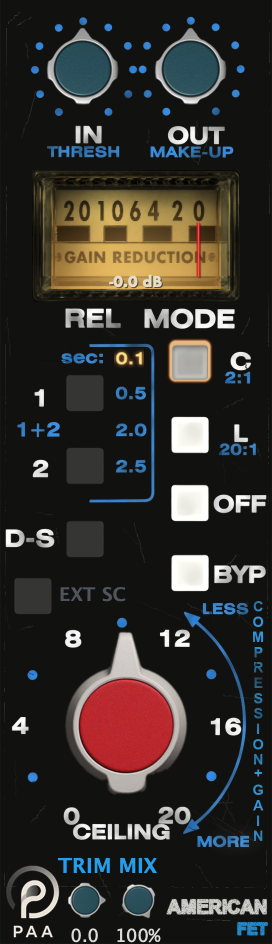
- The factory measured every single one before it shipped. Fixed readings, pass or fail. American FET is calibrated against that same list and hits all six level readings, in Compress and in Limit.
- Hear it before you pay for it. Further down: the same take with the plug-in in and out, level-matched so nothing wins by being louder. Switch between them and decide.
- One knob does the work. CEILING sets the squeeze and hands the level straight back, so you can lean on it and still land where you started.
- Colour with the compressor switched off. MODE OFF keeps the discrete amp and the transformer in the path, so you get console weight on tracks that need no compression.
- The circuit is solved while your audio runs through it. The JFET on its real curve, discrete op-amps as transistor stages, the transformer with its own iron.
It's a fast one. A JFET does the gain riding, so the grab lands before the transient is over, and the discrete op-amps behind it push back with their own colour while it works. Put it on a room mic and distance turns into weight; on a snare it finds the stick. On a vocal it holds the line without ever sounding like it's holding anything.
There's a reason this design still turns up in racks that already have three other compressors in them. Subtlety isn't the job here. Drums come back sounding like a record instead of a session, and you hear it from across the room, not after the third A-B.
Down to the parts
- The CEILING steps come off the resistor ladder in the schematic. 2 dB per step, measured off the parts rather than fitted to a curve.
- The D-S sidechain filter comes off the switch network in the schematic, including the part nobody notices: it lifts the deep bass as well as the top.
- The output transformer is the type the original was built with, modelled with its own iron. Drive it and it saturates instead of just getting louder.
- The detector reconstructs its peak between samples, at around 380 kHz whatever rate your session runs at, so short transients are caught where a plain digital detector reads low.
All of it is written down, including the places where the model still differs from the measured hardware.
Colour without compression
Switch MODE to OFF and the gain cell steps out of the way, but the discrete output amplifier and the transformer stay right where they are. Now OUT isn't a make-up control any more, it's a drive control: push it, and pull TRIM back afterwards to land the level where you want it.
On a quiet source that path stays clean. Feed it a hot track and lean on OUT and the iron starts working, third harmonic well ahead of the second, the way a push-pull output stage saturates. That's console weight on a track that needs no compression at all. Most compressors make you choose between the two. This one doesn't.
What you get
- Four modes: C for 2:1 compression that stays out of the way, L for 20:1 limiting that stops things dead, OFF for the amp and transformer without the dynamics, BYP for a true bypass.
- CEILING is the only control the compression itself needs. One sweep takes you from a gentle couple of dB to full-tilt limiting.
- Four release times off the front panel, from 0.1 s snap to 2.5 s glue.
- D-S tilts the detector towards the top end. On voices it becomes a de-esser without a separate plugin.
- External sidechain, dual / stereo-link / mono modes, dry-wet mix for parallel work, and a post-transformer TRIM so you can drive the iron and still hit your level.
- Peak-hold readout under the meter so you can see what it actually took off.
Why it's different: PCCN™
Conventional DSP models the result: a fixed saturation curve, an impulse response, a neural capture of one day's behaviour. PCCN models the cause: the circuit is solved while the audio runs through it. You hear that where a curve cannot reach. The knee comes out of the rectifier in the detector, the ratio steepens as the gain cell runs out of room, and driving the output makes the transformer answer before the amplifier does.
American FET is not affiliated with, endorsed by, or licensed from the manufacturer of the original hardware. All product names and trademarks are the property of their respective owners and are used only to describe what this plug-in models.
Hear what it does
The same take in every player, once without and once with the plug-in. Everything is loudness-matched, so nothing wins by being louder. The colour player is the one exception, see below. Source material used with permission.
Drums: dry vs plug-in
Vocal: dry vs plug-in
Colour only: MODE OFF, OUT driven
The colour player is the one exception: those two are matched by peak level, not by loudness. That is the whole point of it: at the same peak, the driven version simply carries more.
Web clips only tell you so much. The real test is your own material. Download the free demo and A-B it on your own tracks.
Try before you buy
Download the installer and run it in Demo Mode: everything works, and a short noise burst plays every minute and a half. When you buy, right-click the plugin, choose “Activate License”, pick your file, and the burst is gone.