
Solid Channel
One channel of a British large-format console: filters, four-band EQ, compressor and expander. Built to sound and behave as close to the original hardware as a plugin can.
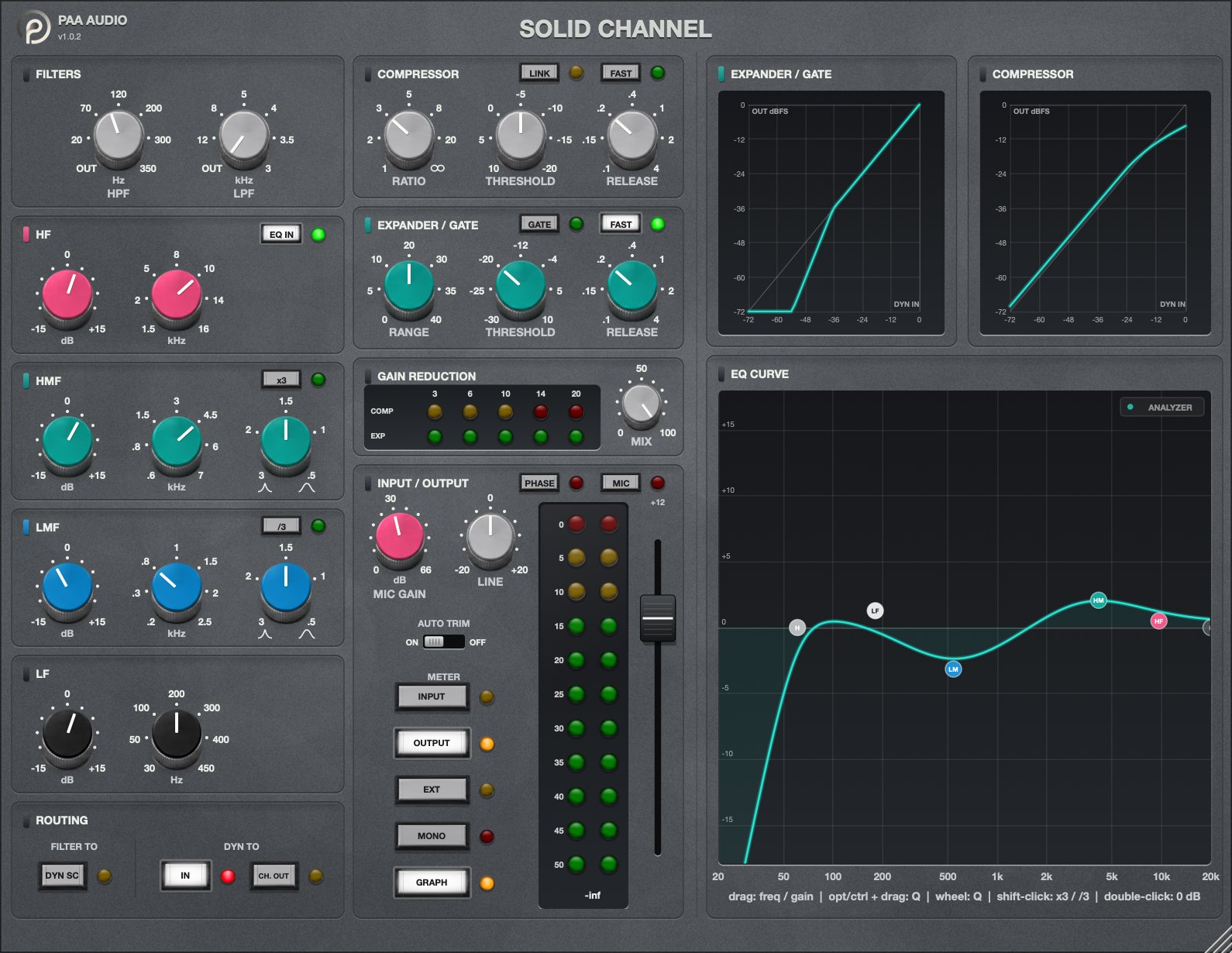
What's in it
- Input: line amp (-20 to +20 dB) and a mic preamp (0 to 66 dB), phase switch. AUTO TRIM takes the added gain back at the output, so you hear the drive without the channel getting louder.
- Filters: high-pass and low-pass, each can be moved into the sidechain of the dynamics.
- EQ: HF and LF shelves, two mid bands with Q, x3 on the high mid and /3 on the low mid.
- Compressor: ratio up to limiting, threshold, release, fast or programme-dependent attack. No make-up knob, it does that by itself.
- Expander / gate: range up to 40 dB, threshold, release, fast or slow attack.
- Routing: dynamics before or after the EQ, external sidechain, stereo link, a MIX knob for parallel compression.
- On stereo tracks it runs two channels with slightly different component values, like two real channels. Their own noise and a little hum are in too; you can switch that off in the menu.
- MONO: sums left and right and runs only one channel. On mono sources in a stereo track this halves the CPU load.
- Graph panel: the EQ curve, which you can also set by dragging its handles, with an analyzer behind it. Above it, the curves of the compressor and expander for the current settings, for display only.
- Factory and user presets, copy and paste between instances, 44.1 to 192 kHz.
A bit of history
In 1987 a British company brought out the last generation of its large-format console. The one before it was already in most of the big studios, and within a few years the new desk stood in many of them too. What made these consoles special was simple: every single channel had its own compressor and gate right next to the EQ. You could shape drums, bass and vocals on the desk itself, without a rack of outboard gear, and a computer could recall the whole mix the next day.
The new generation came with a revised EQ, easy to spot by its pink knobs, and engineers simply called it the pink EQ. Through the late 80s and the 90s a huge number of pop, rock and hip-hop records went through channels like this one, often every track of a song on the same desk. Drums that hit hard and stay in their place, vocals that sit right in front: a lot of that sound came from here.
A working console of this kind costs as much as a house and needs its own room and a technician. Solid Channel gives you one of its channels on every track of your session.
How it sounds
Many channel strip plugins add something on top of the signal: a bit of saturation, a tone curve. You hear the effect, and the source sits a little smaller behind it. On the console it works the other way round. The colour comes from the circuit reacting to the signal itself, so it moves with the music, and the source gets bigger instead of smaller.
That is what I built it for. The distortion rises and falls with the level of every note, and the compressor and gate work through the real detector and VCA circuit. On a stereo track the two sides are two slightly different channels with their own noise, so the image keeps its width and depth. Quiet passages don't drop into digital silence, and when you drive the input hard it stays free of aliasing, the harsh digital artefact that often gives plugins away.
PCCN™
PCCN is the engine I use for all my plugins. It calculates the actual circuit while your audio runs through it, instead of applying a fixed curve or a recorded response. That is why the channel reacts to level and to every knob the way the circuit does, and why it needs more CPU than a simple EQ.
Solid Channel is not affiliated with, endorsed by, or licensed from the manufacturer of the original console. All product names and trademarks are the property of their respective owners.
Hardware or plugin?
The same recording, once through a real channel of the console and once through Solid Channel with the same settings. Level matched, mono, no other processing. Each example loops until you stop it; switch between A and B while it plays.
Vocal, straight through the channel
Vocal, heavy compression
Drums, gentle compression
Drums, gate with 40 dB range
Drums, compression and gate
Bass, heavy compression
As a blind test
Nine examples without labels, each played A, B, A, B, with the settings on screen. The answer comes right after each one.
Plays from YouTube. Clicking loads the video from YouTube (Google), see the privacy policy.
Questions
- Do I need an iLok or an online account?
- No. You get a licence file by email and load it once in the plugin (right-click, Activate License). There is no iLok and no online check, so it also works on studio computers without internet.
- On how many computers can I use it?
- On all of your own computers. The licence is tied to your name and email, not to a machine.
- Which systems and formats?
- macOS 11 or newer on Apple Silicon and Intel: VST3, AU and AAX. Windows 10 and 11 (64-bit): VST3. The Windows AAX version is not finished yet and will follow as a free update. Linux (64-bit x86): VST3.
- How heavy is it on the CPU?
- Heavier than a typical EQ or compressor plugin, because the circuit is calculated while the audio runs through it. Mono tracks need about half of a stereo instance. The demo is the best way to find out how it runs on your computer.
- What does the demo do?
- Everything works and there is no time limit. Every 100 seconds a few seconds of quiet noise are mixed in. When you activate a licence, that stops.
- Why is there no make-up gain knob?
- The compressor makes up the lost level by itself, depending on ratio and threshold, as on the console. For anything else there is the fader, which goes up to +12 dB.
- Are updates included?
- Yes. You pay once and updates are free.